


Collect solar heat
Sunlight heats water in the evacuated glass tubes.
**BiAGUA Configuration and Operating Principle** BiAGUA brings solar distillation and domestic water heating together in one compact, passive system. Its principal components are inverted evacuated glass tubes, stainless steel vapor conduits, an internal condenser, a thermally insulated hot water tank, and an elevated makeup tank. **Water Supply and Level Control** The elevated makeup tank supplies water by gravity and maintains the operating water level in the upper portion of the evacuated glass tubes. Above the water surface, the closed upper end of each tube provides a cylindrical steam chamber. A vent and overflow connection at the middle of the condenser allows the system to breathe as the water level changes. During filling, rising water displaces air from the glass tubes through the vapor conduits into the condenser, where it escapes through the vent. When the water level falls, air returns through the same passage to occupy the space above the water. Depending on operating conditions, the vent may discharge air, water vapor, or a mixture of both. This connection also provides an outlet for excess distilled water. By limiting the liquid level inside the condenser, it helps prevent accumulated water from obstructing the vapor inlets. **Solar Heating and Vapor Flow** Sunlight absorbed by the evacuated tubes heats the water inside them, causing evaporation. The vapor collects in the steam chambers above the water surface. As vapor accumulates, a slight pressure builds up relative to the condenser, driving it into the open inlets of the vapor conduits and downward into the condenser. Each conduit inlet is positioned near the top of its steam chamber, above the operating water level. The space between the water surface and the inlet allows liquid droplets to separate from the vapor. Adequate chamber height helps reduce the carryover of splashes and droplets containing dissolved impurities, contributing to the purity of the collected distilled water. **Condensation and Heat Recovery** Inside the condenser, vapor transfers heat through the stainless steel wall to the surrounding domestic water. As it releases this heat, the vapor condenses into liquid water, which is collected separately. Distilled water and domestic hot water leave the system through separate outlets, keeping the two water streams apart. These processes occur in a coordinated sequence within a highly insulated thermal boundary. The vacuum insulation of the glass tubes and the insulation surrounding the tank reduce heat loss to the environment. Heat can also pass from the vapor conduits to the surrounding water inside the glass tubes wherever a temperature difference permits. This internal heat transfer helps retain energy within the system and can contribute to further evaporation. In the condenser, the heat released during condensation is recovered for domestic water heating. **One Solar Input, Two Useful Outputs** BiAGUA uses collected solar heat first to evaporate water, then recovers heat from the condensing vapor to warm domestic water. Distillation separates water from dissolved salts and other nonvolatile impurities, while heat recovery gives the same energy a further useful purpose. Through this integration, one solar input provides two useful outputs: distilled water and domestic hot water. The core process operates passively, without electric pumps, filter cartridges, or reverse-osmosis membranes.
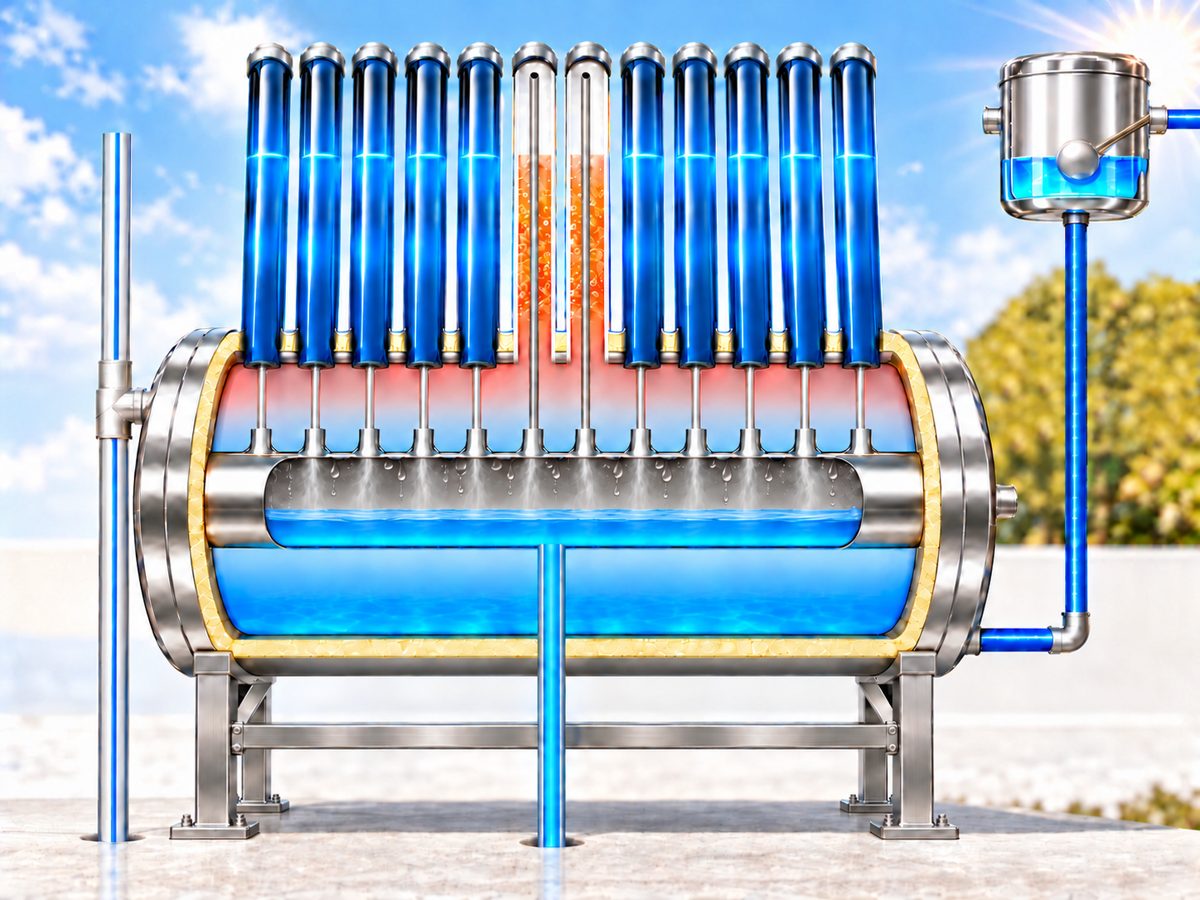
Sunlight heats water in the evacuated glass tubes.
Water evaporates; vapor gathers above the water level.
Stainless-steel conduits carry vapor to the condenser.
Vapor forms distilled water as its released heat warms the tank.
Collect distilled water and draw domestic hot water from separate outlets.

We specialize in the design and manufacturing of advanced solar thermal products, with strong expertise in pre-heat exchanging solar water heaters for residential, commercial, and industrial applications. We are also the developer of Solar BiAGUA solar distillation water heaters with multi-country patents, which will also be applied to solar desalination. Our vision is: “Wherever there is sunlight and sea water, there will be sufficient clean water.”